Results of Research into Use of Supplements
Here are two totally contrasting articles; the bottom line: it all depends
on the supplements you choose.
1. Taking multi-vitamin pills 'does nothing for our health'
Daily Mail, December 28,
2011: Research shows vitamin takers are just as likely to develop cancer or heart disease as those who take no
tablets.
 They are a daily essential for millions of Britons hoping to ward off ill-health. But despite the millions of pounds spent on vitamin pills, they do nothing for our
health, according to a major study.
Researchers spent more than six years following 8,000 people and found that those
taking supplements were just as likely to have developed cancer or heart disease as those who took an identical-looking
dummy pill.
And when they were questioned on how healthy they felt, there was hardly any
difference between the two groups. Experts said the study – one of the most extensive carried out into vitamin pills –
suggested that millions of consumers may be wasting their money on supplements.
Many users fall into the category of the ‘worried well’ – healthy adults who believe
the pills will insure them against deadly illnesses – according to Catherine Collins, chief dietician at St George’s
Hospital in London.
She said: ‘It’s the worried well who are taking these pills to try and protect
themselves against Alzheimer’s disease, cancer, heart attacks and strokes. ‘But they are wasting their money.'
'This was a large study following people up for a
long period of time assessing everything from their mobility and blood pressure to whether they were happy or felt
pain.’
Multi-vitamin supplements have become increasingly popular as a quick and easy way of
topping up the body’s nutrient levels. But a series of studies have indicated that, for some people, they could actually be
harmful.
Two studies published last year suggested supplements could raise the risk of
cancer.
One found pills containing vitamin E, ascorbic acid, beta-carotene, selenium and zinc
increased the risk of malignant melanoma, the deadliest form of skin cancer, four-fold. The other discovered women on a daily multi-vitamin pill increased their risk of
breast cancer by up to 20 per cent.
While the evidence that vitamins can do harm is still limited, the latest study seems
to confirm that many people are at the very least taking them unnecessarily. A team of French researchers, led by experts at Nancy University, tracked 8,112
volunteers who took either a placebo capsule, or one containing vitamin C, vitamin E, beta-carotene, selenium and
zinc, every day for just over six years.
They assessed the state of their health at the beginning and end of the trial, taking
a quality of life survey designed to measure everything from mobility and pain to vitality and mental health. When researchers analysed how many in each group had gone on to develop serious
illnesses over the years, they found little difference.
In a report on their findings, published in the International Journal of
Epidemiology, the researchers said: ‘The perception that supplementation improves general well-being is not supported by
this trial.’
Miss Collins said the results of the study ‘reinforce the idea that if you’re worried
about your health and start taking multi-vitamins, you will still be worried about it six years later’.
2. Yes, Fruit and Vegetable Supplements are Effective
Frontier Voice of
Nutrition Remarks (December 13, 2011), Interview with Prof. Cyril Kendall from the Faculty of Medicine, University
of Toronto
 Fruit and vegetable supplements are proven to be effective against heart disease,
inflammation, and oxidative stress. Therefore, they are suggested as an effective option for those who do not eat an
adequate amount of fruits and vegetables. Fruit and vegetable supplements are proven to be effective against heart disease,
inflammation, and oxidative stress. Therefore, they are suggested as an effective option for those who do not eat an
adequate amount of fruits and vegetables.
Dr. Cyril Kendall and his group from the University of Toronto (Canada) have
recently reviewed fruit and vegetable supplement-related human studies published in high-quality scientific journals.
According to his analysis that used 18 human studies with total of 1,663 adults, mixed fruit and vegetable supplements
(Juice Plus+) have promising health benefits against cardiovascular diseases, inflammation, and oxidative stress.
Interestingly, no noticeable negative health effects of those supplements were noted.
Unhealthy food habits and a sedentary lifestyle greatly increase our risk for heart
disease, inflammation, oxidative stress, and even cancer. It is now well known that eating fruits and vegetables greatly
reduces the disease risk due to the high levels of vitamins, minerals, polyphenols, sterols, and fiber found in these
foods. Also, fruits and vegetables are low in fat and calories. However, in order to receive these nutritional benefits,
we need to eat fruits and vegetable on a daily basis and maintain their active beneficial compounds at
high levels in the body. Their benefits are more effective when those compounds are readily available to continuously
fight against unhealthy reactions inside our body.
However, those who do not eat an adequate amount of fruits and vegetable still have an
effective option: mixed fruit and vegetable supplements.
Dr. Kendall is a renowned scientist with expertise in dietary bioactive compounds and
prevention of chronic health diseases including heart disease, cancer, and diabetes. Nutrition Remarks interviewed him
regarding their recent findings. A simplified version of the conversation is as follows:
Question from Nutrition Remarks: What makes fruit and vegetable
supplements important in today’s society?
Answer from Dr. Kendall: There are many social and economic reasons
that contribute to less fruit and vegetable consumption in today’s society. Fast food is convenient and popular. Most
people do not see the risk until they face consequences such as obesity, diabetes, heart diseases, etc. Compounds in
fruits and vegetable are not only safe but also have preventive benefits against those conditions. Those who do not eat
fruits and vegetable on a daily basis can benefit with fruit and vegetable supplements, according to the available
scientific evidence.
Question: What are the compounds in fruits and vegetables that prevent
us from those serious diseases? And how they are important?
Answer: Fruits and vegetables contain the following compounds, and they
provide protection:
a) Vitamins – Anti-oxidants, anti-inflammatory
b) Plant sterols – Lower cholesterol
c) Polyphenol compounds – Multifunctional (Anti-oxidant, anti-cancer, anti-obesity,
etc.)
d) Fiber – Insoluble fiber helps healthy digestion, and soluble fiber lowers
unhealthy cholesterol
Question: Why do we need to eat fruits and vegetables frequently, and
why are supplements a good option?
Answer: We need to maintain those bioactive compounds in our body at
high enough levels to counteract against unhealthy events like oxidative stress, high cholesterol, and blood sugar.
Question: What about low-grade inflammation that we don’t pay much
attention to; is it dangerous?
Answer: Yes, there is chronic low-grade inflammation associated with
obesity, diabetes, and even with just high-fat food consumption. Low-grade inflammation is a significant health risk,
and frequent consumption of bioactive compounds in fruits and vegetables is one of the best ways to counter this.
Question: What is your message to those who do not eat enough fruits
and vegetables but want to be healthy?
Answer: It is always good to eat fruits and vegetables frequently. For
those who do not meet the recommended intake levels, mixed fruit and vegetable supplements (Juice Plus+) are an effective option, and
we have scientific evidence to indicate that these supplements have several other benefits.
From the above articles, it's clear that the money spent on traditional vitamin and
mineral supplements is, at best a waste of money, and at worst a danger to our health. Whereas taking
Juice Plus+ is proven to be beneficial, with "no
noticeable negative health effects" according to Dr. Kendall. You can read about the research that
Dr. Kendall used to draw his conclusions
here.
Almost all of us need some way to bridge between what we actually
eat and what we need to eat for good health. That's why many of us are "worried
well"
and take supplements.
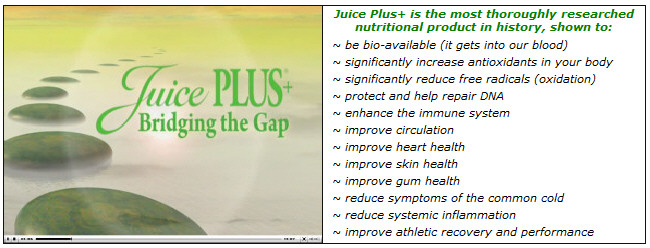
For us Juice Plus+ is that bridge. What's yours? At about $10 a
week per adult, it's terrific value; and each adult can sponsor a child (between
4 yrs. and full-time college age) to get their Juice Plus+ free!
Please watch the video below to fully understand this concept. Let us know if
you are ready to get started, or want another family member to also benefit from Juice Plus+.
|