|
Juice Plus+ Sports Research
Exercise is good for us. Yes, of course! However, all athletes (and the parents of young athletes) need to understand the negative
effects of exercise, and how to combat them through nutrition.
The only nutritional supplement clinically proven
to provide the protection that athletes need is... Juice Plus+.
Most importantly, Juice Plus+ is NSF Certified for Sport. This program involves additional screening that ensures that each specific batch of product that is certified for sport does not contain any substances that have been banned or prohibited by major U.S. and Canadian sports organizations. Major League Baseball (MLB), the MLB Player’s Association, the National Football League (NFL), the NFL Players Association, the Professional Golfers Association of America (PGA), the Ladies Professional Golf Association (LPGA), and the Canadian Centre for Ethics in Sport (CCES) have all chosen NSF Certified for Sport program to help verify that the products their athletes use are safe and free of banned substances.
 This is why Juice Plus+ was the official nutritional support for the German, Swiss and Austrian teams training for the 2012 Olympics in London, as well as many other Olympic and world class athletes around the world. This is why Juice Plus+ was the official nutritional support for the German, Swiss and Austrian teams training for the 2012 Olympics in London, as well as many other Olympic and world class athletes around the world.
Juice Plus+ is the most thoroughly studied and proven nutritional product in history, and has been tested on elite athletes in several different environments. You can read an overview of all the research here, and more on sports research below.
Two articles
published in the Journal of Medicine & Science in Sports & Exercise and the Journal of Nutrition, documented an in-depth study of 41 highly trained men (Austrian special forces, aka the 'Cobras') consuming Juice Plus+ for 28 weeks.
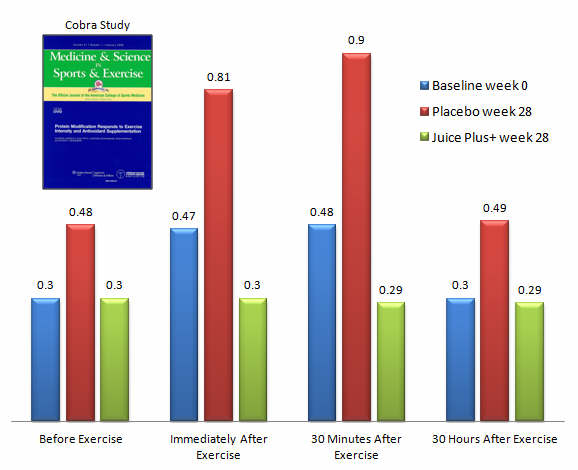
Juice Plus+ was shown to completely nullify the oxidative stress experienced by these men while exercising to Vo2max80.
Here is a graphical summary of the results of this study:
-
41 Cobras (special forces); 28
weeks; standardized diet and exercise (endurance & weights)
-
Groups on placebo or Juice Plus+
Orchard, Garden and Vineyard Blends (standard amount)
-
Duty hours increased 45% from week 1
to week 28
-
Standard exercise test: 40 minutes
on stationary bike at 0, 4, 16 and 28 weeks
-
Measured Protein Carbonyls and
other markers of oxidation
At the end of the 28 week period, with their workout intensity ramped up
to the maximum, their duty hours increased by 45%, and with the accumulative effect of oxidative stress kicking in, compared to the placebo group whose
oxidative stress (carbonyl proteins) was measured at 0.9 after exercise and still raised to 0.5 30 hours later, the Juice Plus+ group saw NO
change in their levels, which remained at the same, normal 0.3 level as the
before exercise baseline (at the start of the 28 weeks).
All the studies on Juice Plus+ in serious athletes have demonstrated
impressive results:
 Medicine & Science in Sports & Exercise 2006 (full article) - Study findings: Juice Plus+ supplementation for 2 weeks attenuated the rise in protein carbonlys after 30 minutes of aerobic exercise, even after
a 1 week washout. Medicine & Science in Sports & Exercise 2006 (full article) - Study findings: Juice Plus+ supplementation for 2 weeks attenuated the rise in protein carbonlys after 30 minutes of aerobic exercise, even after
a 1 week washout.
Journal of Nutrition 2007 (full article) - Study findings: Several indicators of oxidative stress, immunity, and illness improved in 41 highly trained men (special forces) consuming Juice Plus+ for 28 weeks.
Medicine & Science in Sports & Exercise 2009 (full article) - Study findings: Exercising at 80% VO2max intensity, the Juice Plus+ group (compared to placebo) had lower baseline protein carbonyl levels after 16 and 28 weeks and no exercise-induced protein carbonyl increase. Human mercaptalbumin, another marker of exercise-induced oxidative stress, was also significantly lowered.
Medicine & Science in Sports & Exercise 2010 - Study findings: This study reports that 4 weeks of pretreatment with Juice Plus+ can attenuate blood oxidative stress markers induced by an acute bout of eccentric exercise, but had no significant impact on the functional changes related to pain and muscle damage.
In each of these studies, the all-important training effect was supported by Juice Plus+ while dramatically reducing the exercise-induced oxidative stress. The training effect of exercise (aka adaptation) is vital for the athlete to gain in strength and endurance - for example, muscle tissue must break down and be repaired to grow stronger.
 However, excessive damage caused by exercise-induced oxidative stress is to be avoided if possible. This study again demonstrates what all Juice Plus+ athletes know from their own experience: that those who take Juice Plus+ have less oxidative damage, while fully benefiting from their training. However, excessive damage caused by exercise-induced oxidative stress is to be avoided if possible. This study again demonstrates what all Juice Plus+ athletes know from their own experience: that those who take Juice Plus+ have less oxidative damage, while fully benefiting from their training.
More on Juice Plus+ in Sports:
Juice Plus+ Research in Elite Athletes
Juice Plus+ for Sports Recovery & Fitness
The Role of Antioxidants and Juice Plus+ in the Endurance Athlete
Dr. David Phillips on Fueling for Peak Performance
|